

Signs Your Website Is Costing You Customers
By Trevor Williams4 min read
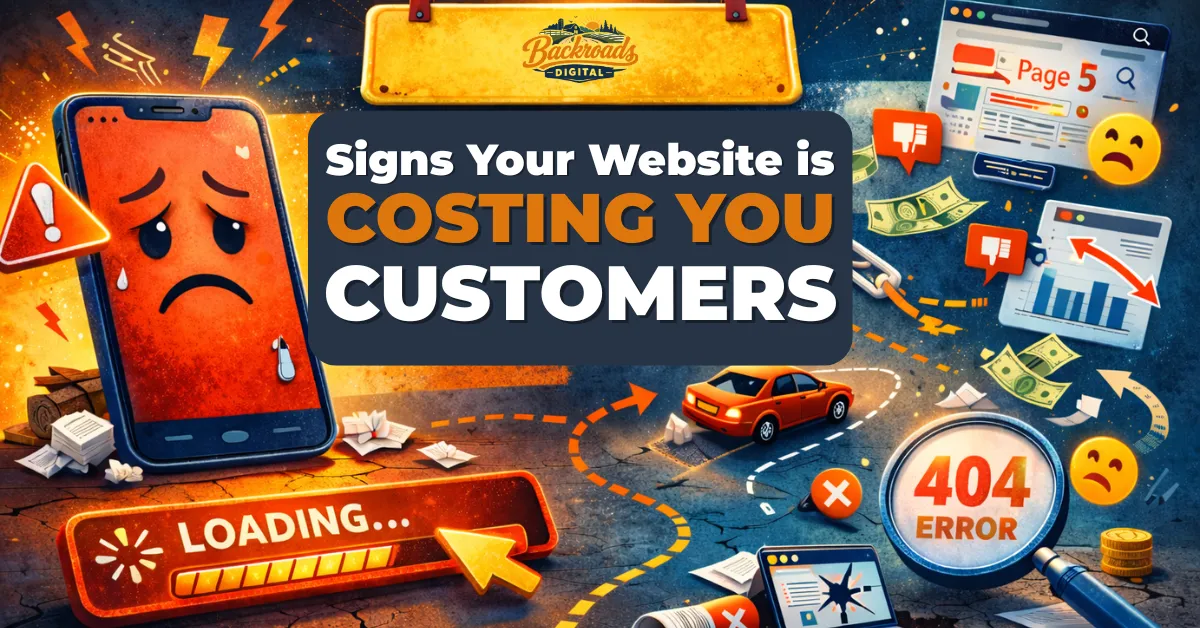
Most small business owners assume that if they have a website, they’re covered.
But here’s the hard truth: A website can exist… and still quietly cost you customers.
If your site isn’t designed with small business website optimization in mind, it may be turning away potential leads without you realizing it.
Here are the most common signs your website may be hurting your business instead of helping it.
1. You’re Getting Traffic, But No Inquiries One of the clearest signs your website is costing you customers is this: You’re getting website traffic… But no calls. No form submissions. No bookings.
This usually isn’t a traffic problem. It’s a website conversion problem.
A high-converting website should:
- Clearly explain what you do
- Speak directly to your ideal customer
- Make the next step obvious
If visitors don’t know what to do within seconds, they leave. That’s lost revenue.
2. Your Website Isn’t Mobile-Friendly For local businesses especially, most visitors are searching on their phones.
If your site:
- Loads slowly on mobile
- Has tiny text
- Has buttons that are hard to tap
- Requires too much scrolling
You’re losing customers.
A mobile-friendly website for small business owners isn’t optional anymore. It’s essential for both SEO and conversions.
Google also prioritizes mobile usability in search rankings. So poor mobile design affects both visibility and sales.
3. It Loads Too Slowly Website speed directly impacts:
- User experience
- Search engine rankings
- Conversion rates
If your website takes more than a few seconds to load, potential customers may never even see your content.
A slow website can:
- Increase bounce rates
- Lower Google rankings
- Reduce customer trust
Speed optimization is one of the most overlooked elements of small business website performance.
4. Your Messaging Is Confusing If someone lands on your homepage and has to ask: “What exactly do they do?” You have a clarity problem.
Strong website messaging should immediately answer:
- What do you offer?
- Who is it for?
- Why should I choose you?
- What should I do next?
Clear messaging improves website conversion rates because it removes friction. Confused visitors don’t convert.
5. There’s No Clear Call to Action If your website doesn’t clearly tell visitors what to do, most won’t take action. A strong call to action (CTA) might say:
- Schedule a Consultation
- Request a Quote
- Call Today
- Get Started
Without visible and repeated calls to action, even interested visitors leave without engaging.
That’s a missed opportunity.
6. It Looks Outdated An outdated website can damage trust, even if your business is excellent. Design trends evolve. Customer expectations change.
If your website:
- Looks old
- Has broken links
- Contains outdated information
- Uses low-quality images
Visitors may question your professionalism.
For local businesses, credibility is everything. An outdated website can quietly push customers toward competitors.
7. There Are No Trust Signals Before someone hires a local business, they look for reassurance.
If your website lacks:
- Reviews
- Testimonials
- Case studies
- Clear contact information
- Professional branding
Visitors hesitate.
Trust signals are a critical part of local business website optimization. They reduce doubt, and doubt is what stops conversions.
8. It’s Not Optimized for Search Engines (SEO) If your website isn’t optimized for local SEO, customers may never find you in the first place.
Search engine optimization for small businesses includes:
- Keyword optimization
- Proper page titles and meta descriptions
- Clear site structure
- Fast load speeds
- Mobile responsiveness
Without SEO, your website becomes invisible, no matter how nice it looks.
And an invisible website definitely costs customers.
9. It Doesn’t Reflect Your Current Services If your website doesn’t match what you actually offer today, you create confusion.
Outdated service pages can:
- Attract the wrong leads
- Repel qualified customers
- Undermine credibility
Your website should accurately represent your business as it exists right now, not how it looked three years ago.
10. You Haven’t Reviewed It in Years Websites aren’t “set it and forget it.” They need:
- Updates
- Content improvements
- Performance reviews
- SEO adjustments
- Conversion optimization
A website that isn’t maintained slowly loses effectiveness over time.
That’s how businesses end up wondering why calls have slowed, even though “nothing changed.”
Something did. The online landscape moved forward.
The Real Cost of an Underperforming Website When your website isn’t optimized for conversions and local visibility, the cost isn’t obvious.
It’s:
- The customer who chose a competitor
- The lead who never filled out the form
- The call that never happened
- The opportunity that disappeared
A poorly optimized website doesn’t fail loudly. It fails quietly.
Final Thoughts Your website should work like a 24/7 salesperson for your business.
It should:
- Attract visitors through local SEO
- Clearly communicate your value
- Build trust
- Guide visitors toward action
- Convert traffic into customers
If it’s not doing those things, it may be costing you more than you realize.
Not sure if your website is helping or hurting? If you’re unsure whether your website is optimized for conversions and local search visibility, that’s a common place to be.
When you’re ready, we’re happy to take a look and help you improve it.
Want help with this?
Fast, mobile-friendly websites built to turn visitors into calls, plus redesigns of sites that are falling behind.New sites $1,500 to $4,000. Redesigns from $1,200