

Why Likes Don’t Matter (But Engagement Does)
By Trevor Williams7 min read
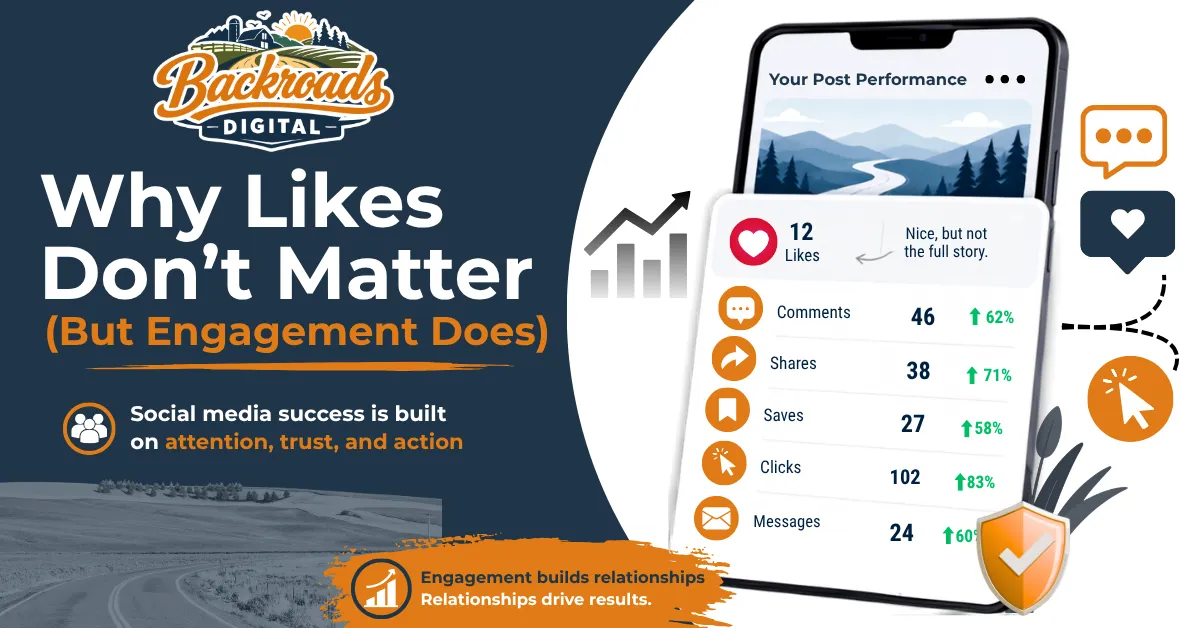
When businesses look at their social media performance, one of the first numbers they tend to notice is how many likes a post received. Likes are easy to see, easy to understand, and can make a post feel successful at a glance. The problem is that likes alone don’t tell you very much about whether your social media is actually helping your business grow.
For a small business, a post with 100 likes but no comments, shares, clicks, messages, or customer inquiries may be less valuable than a post with 20 likes that gets people talking, visiting your website, or reaching out for more information. That is why businesses should focus less on collecting likes and more on creating meaningful engagement.
What Is Social Media Engagement?
Social media engagement is the way people interact with your content beyond simply seeing it in their feed. Engagement can include likes, comments, shares, saves, link clicks, direct messages, profile visits, video views, replies, tags, and mentions. In some cases, it can also include actions that happen away from the platform, such as someone calling your business or visiting your website after seeing a post.
Likes are technically a form of engagement, but they are usually one of the easiest actions a person can take. A customer who takes the time to comment, share your post with a friend, save it for later, or send your business a message is showing a much stronger level of interest. Those actions are often a better indicator that your content is connecting with the right audience.
Why Likes Don’t Matter as Much as Engagement
A like can happen in less than a second. Someone may tap the Like button while scrolling and immediately move on to the next post without giving your business another thought. While that interaction is not meaningless, it does not necessarily show that the person is interested in becoming a customer.
Meaningful engagement requires more effort. When someone asks a question in the comments, shares a post with a friend, clicks through to your website, or sends you a direct message, your content has encouraged them to take another step. That is much closer to what social media marketing should accomplish for a business.
The goal is not simply to make people acknowledge that your post exists. The goal is to build enough attention, familiarity, and trust that your business comes to mind when someone needs the product or service you provide.
Engagement Helps Build Relationships With Potential Customers
Most customers do not see one Facebook or Instagram post and immediately decide to make a purchase. More often, they become familiar with a business gradually. They may see a helpful post today, a customer review next week, a behind-the-scenes photo later in the month, and a promotion a few weeks after that.
Over time, those repeated interactions help your business become familiar. When that person eventually needs what you offer, your company is no longer a complete stranger. They have seen your name, your employees, your work, your products, or your personality before.
That familiarity can be especially important for small and local businesses. In smaller communities, customers often choose businesses they recognize and trust. Social media gives businesses the opportunity to build some of that familiarity before a customer ever walks through the door, makes a phone call, or requests an estimate.
Engagement Can Help Increase Social Media Reach
Social media platforms are designed to keep people interested and active. When users comment on, share, save, watch, or otherwise interact with content, those actions can help indicate that the content is relevant or interesting. As a result, engaging content may have a better opportunity to reach additional people organically.
This does not mean that every local business needs hundreds of comments or thousands of shares on every post. In fact, chasing large numbers can sometimes distract businesses from the audience that matters most. A local company does not necessarily need national attention if almost none of those people could realistically become customers.
For example, a contractor serving Bonham and the surrounding North Texas area would usually benefit more from reaching homeowners in those communities than from generating thousands of views across the country. Relevant engagement from the right people is often more valuable than high engagement from an audience that will never buy from you.
A Smaller Engaged Audience Can Be Better Than a Large Passive One
Follower counts can be misleading for the same reason. Having thousands of followers may look impressive, but those followers do not provide much value if they rarely interact with the business.
Imagine one company has 5,000 followers but receives almost no comments, shares, messages, website traffic, or customer inquiries. Another company has 750 followers, but customers regularly comment, tag friends, respond to promotions, and ask questions. The second company may actually have the healthier social media presence because its audience is paying attention.
A smaller group of engaged followers who recognize your business and regularly interact with your content can be much more valuable than a large audience that scrolls past everything you post.
What Kind of Engagement Should Small Businesses Look For?
The most important engagement metrics depend on what you are trying to accomplish. If the goal of a post is to generate leads, link clicks, direct messages, calls, quote requests, and website visits may be among the most important measurements. If your goal is brand awareness, reach, shares, video views, and profile visits may matter more.
For businesses focused on community relationships, comments, tags, mentions, and conversations can be especially valuable. A restaurant, for example, may get more value from a customer commenting, “We need to go here Friday,” and tagging a friend than it gets from ten anonymous likes. A roofing company may care far more about one homeowner sending a message asking for an estimate than receiving another 50 reactions.
The key is to connect the metric to the purpose of the post. Instead of asking whether a post received enough likes, ask whether the post encouraged the audience to do something meaningful.
How Can Small Businesses Get More Engagement?
Better engagement usually starts with creating content that gives people a reason to stop scrolling. Businesses that use social media only to advertise products or repeatedly tell people to “buy now” often struggle to create real interaction because there is little reason for the audience to participate.
A stronger content strategy mixes promotional posts with useful, entertaining, educational, and community-focused content. Customer stories, employee spotlights, behind-the-scenes photos, helpful tips, frequently asked questions, short videos, local information, testimonials, and occasional promotions can all give your audience more opportunities to connect with your business.
Businesses should also remember that social media is meant to be social. When someone leaves a thoughtful comment, respond when appropriate. When a customer compliments your business, thank them. When someone asks a question, answer it. Those small interactions help show that there are real people behind the page and can strengthen the relationship between your business and its audience.
Measure What People Do After Seeing Your Content
Instead of asking, “How many likes did this post get?” businesses should start asking, “What did people do after they saw it?”
Did they comment or share it? Did they visit your profile or website? Did someone send you a message? Did the post start a conversation? Did customers mention seeing it when they visited your business? Those types of actions provide a much clearer picture of whether your social media strategy is accomplishing something useful.
Not every post needs to generate a sale immediately. Social media often works over time by keeping your business visible and familiar. The value comes from consistently showing up in front of the right audience and giving those people reasons to remember and trust your business.
Social Media Success Is About Attention and Trust
Likes can be encouraging, and there is nothing wrong with wanting people to react positively to your content. They just should not be the primary way you decide whether your social media marketing is successful.
For most small businesses, the bigger goal is to earn attention, build trust, stay visible, create conversations, and encourage potential customers to take action when they are ready. A post that helps accomplish those things is valuable even if it never receives hundreds of likes.
At Backroads Digital, we help small and local businesses create consistent social media strategies designed to do more than simply fill a content calendar. The goal is to help businesses stay visible, connect with their communities, and build stronger relationships with the people most likely to become customers.
Because at the end of the day, likes might make a post look successful, but meaningful engagement is what helps make social media useful for your business.
Need Help Improving Your Social Media Engagement?
If your business is posting regularly but your audience does not seem to be responding, the problem may not be how often you post. Your content strategy may simply need to give people more reasons to interact.
Backroads Digital helps small and local businesses build consistent, professional social media presences without having to spend hours managing their pages themselves. If you are ready to improve your social media strategy and create content that connects with your audience, contact Backroads Digital to learn how we can help.
Frequently asked questions
Are Facebook and Instagram likes important for businesses?
Likes can be useful because they show that someone noticed or enjoyed a post, but they should not be the primary measurement of social media success. Comments, shares, saves, website clicks, direct messages, inquiries, and other meaningful actions usually provide a better picture of whether your content is connecting with potential customers.
What is considered good social media engagement?
Good social media engagement occurs when your audience actively interacts with your content. For a small business, meaningful comments, shares, saves, messages, website visits, inquiries, and customer conversations can often be more valuable than receiving a large number of likes.
Why is social media engagement important for local businesses?
Engagement helps local businesses build familiarity and trust with potential customers. When people repeatedly see and interact with a business online, they are more likely to recognize and remember that company when they eventually need its products or services.
Does social media engagement help increase reach?
Engagement can signal to social media platforms that users find a post relevant or interesting. Comments, shares, saves, clicks, and other interactions may therefore help content reach additional users, although reach can also depend on many other factors.
How can a small business increase social media engagement?
Small businesses can improve engagement by creating useful, entertaining, informative, and locally relevant content instead of relying entirely on advertisements. Photos, videos, customer stories, employee spotlights, questions, testimonials, helpful tips, and community-focused posts can all encourage more interaction.
Which is more important: followers or engagement?
Both can be useful, but engagement is often a better indicator of the quality of your audience. A smaller group of followers who regularly interact with your business can be more valuable than thousands of followers who rarely pay attention.
Want help with this?
Planned, branded posts with captions and hashtags, scheduled for you, with a monthly report on how they did.From $750 a month