
Backroads Digital
  • Home
  • About
  • Business Services
    • Social Media Management
    • Social Media Setup
    • Website/SEO
    • Email Marketing
    • Text Message Marketing
    • Frequently Asked Questions (FAQ)
  • Media Digitizing
  • Blog
  • Contact

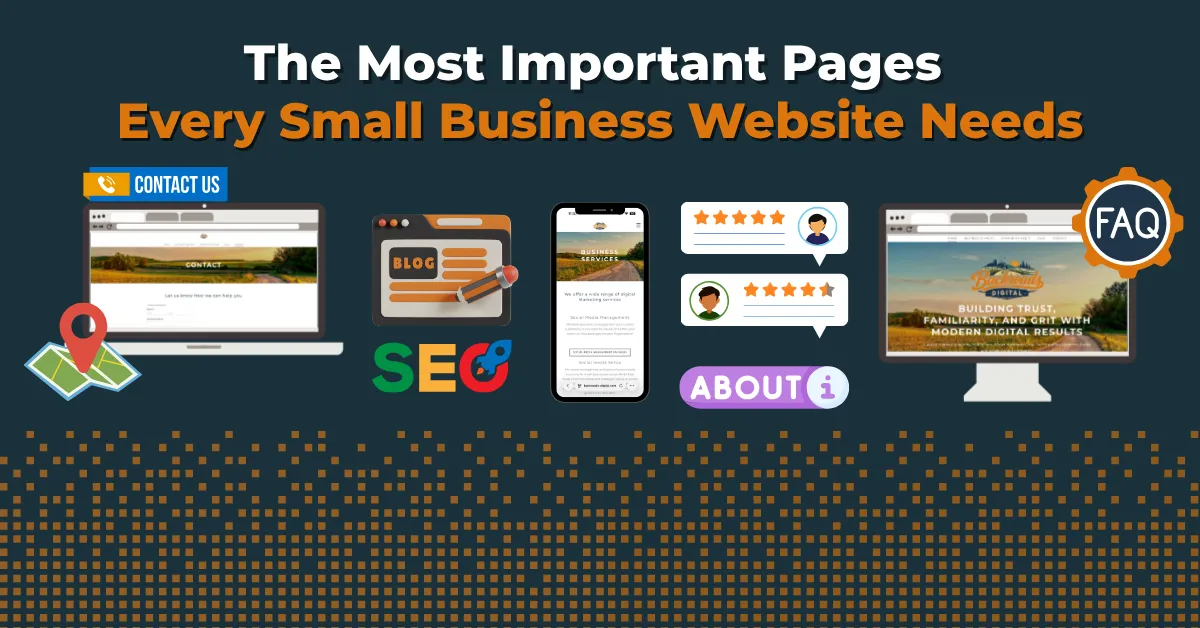
The Most Important Pages Every Small Business Website Needs

3/27/2026

 
Picture
​If you’re a small business owner, having a website is a great first step.

But not all websites are created equal.

​Some websites look nice but don’t actually help bring in customers. Others are simple—but structured in a way that builds trust, answers questions, and leads people to take action.

One of the biggest differences?
Having the right pages.

Let’s walk through the most important pages every small business website needs—and why each one matters.

1. Homepage (Your First Impression)
Your homepage is often the first place people land when they visit your website.
Within just a few seconds, visitors should understand:
  • What you do
  • Who you serve
  • Where you’re located (especially for local businesses)
  • What they should do next
A strong homepage should include:
  • A clear headline
  • A brief explanation of your services
  • Trust signals (reviews, testimonials, or experience)
  • A visible call to action (Call, Book, Request a Quote)
For small business website optimization, your homepage isn’t just about looking good—it’s about guiding visitors quickly.

2. Services Page (What You Actually Offer)
Your services page is one of the most important pages for converting visitors into customers.
This is where people go to answer:
👉 “Can this business help me?”
A strong services page should:
  • Clearly list your services
  • Explain what each service includes
  • Highlight benefits (not just features)
  • Include pricing (if applicable) or next steps
  • Use keywords relevant to your services
For example, instead of just saying “SEO Services,” you might say:
“Local SEO Services for Small Businesses in North Texas”
That helps both customers and search engines understand what you offer.

3. About Page (Build Trust)
Many small business owners underestimate the importance of the About page.
But it’s one of the most visited pages on a website.
Why?
Because people want to know who they’re doing business with.
Your About page should:
  • Tell your story (briefly and clearly)
  • Explain why you started your business
  • Highlight your experience or background
  • Show your connection to the local community
For small-town businesses especially, trust is everything.
A strong About page helps turn interest into confidence.

4. Contact Page (Make It Easy to Reach You)
If someone wants to contact you, it should be as easy as possible.
Your contact page should include:
  • Phone number (click-to-call on mobile)
  • Email address
  • Contact form
  • Business hours
  • Location or service area
Bonus points if you include:
  • A Google Map
  • Quick response expectations (“We respond within 24 hours”)
A confusing or hard-to-find contact page can cost you customers.

5. Reviews / Testimonials Page (Social Proof)
People trust other people.
Before choosing a business, many customers look for:
  • Reviews
  • Testimonials
  • Proof of results
Having a dedicated page (or strong section) for this builds credibility.
This is especially important for:
  • Service-based businesses
  • Local businesses
  • Higher-ticket services
Even a few strong testimonials can make a big difference in website conversion rates.

6. Blog or Resources Page (SEO & Authority)
A blog may not seem essential at first—but it plays a big role in small business SEO.
Blog content helps you:
  • Rank in Google search results
  • Answer common customer questions
  • Show expertise
  • Bring in new visitors over time
For example, blogs like:
  • “What Is Digital Marketing?”
  • “Why Website Speed Matters”
  • “Signs Your Website Is Costing You Customers”
…help potential customers find you before they even know your business name.
Over time, this builds long-term traffic and visibility.

7. FAQ Page (Remove Objections)
An FAQ (Frequently Asked Questions) page helps address concerns before someone reaches out.
This can include:
  • Pricing questions
  • Timeline expectations
  • What to expect when working with you
  • Common concerns customers have
This reduces hesitation and helps people feel more confident moving forward.

8. Location / Service Area Page (For Local SEO)
If you serve specific cities or counties, this is important.
A location page helps you rank for searches like:
  • “digital marketing in Bonham TX”
  • “website design near me”
  • “SEO services in North Texas”
You can include:
  • Cities you serve
  • Local references
  • Directions or service area details
This improves your local search visibility and helps nearby customers find you.

Why These Pages Matter Together
Each page plays a different role:
  • Homepage → First impression
  • Services → Explains what you offer
  • About → Builds trust
  • Contact → Drives action
  • Reviews → Builds credibility
  • Blog → Drives traffic
  • FAQ → Removes hesitation
  • Location → Improves local SEO
When all of these work together, your website becomes more than just an online brochure.
It becomes a tool that helps turn visitors into customers.

Final Thoughts
A well-structured website doesn’t happen by accident.
It’s built with intention.
If your website is missing key pages—or if those pages aren’t clearly guiding visitors—you may be losing opportunities without realizing it.
The good news?
These are fixable problems.
And even small improvements can make a big difference in how your website performs.

Want to Improve Your Website?
If you’re not sure whether your website has the right pages—or if it’s structured in a way that actually converts visitors into customers—we’re here to help.
👉 Explore our Website & SEO Packages to see how we can help you build a website that works.
 
Website/SEO Packages

Why Your Homepage Matters More Than Any Other Page

3/20/2026

 
Picture
When someone looks up your business online, where do they land first?
Most of the time—it’s your homepage.
And in small towns like Bonham, Commerce, or Sulphur Springs, that first impression matters even more. People aren’t just checking out your business… they’re deciding whether they trust you.
Your homepage isn’t just a page—it’s your digital storefront.


Your Homepage Is Your First Impression
Think of your homepage like the front door of your business.
If someone walked into your store and it was cluttered, confusing, or outdated… they’d probably walk right back out.
The same thing happens online.
A strong homepage should immediately answer three questions:
  • What do you do?
  • Where are you located (or who do you serve)?
  • Why should someone choose you?
If visitors can’t figure that out in 5–10 seconds, they’re gone.

It Sets the Tone for Your Entire Business
Before someone ever calls you, visits your location, or sends a message—they’re judging your business based on your website.
A clean, modern homepage tells people:
  • You’re professional
  • You care about your business
  • You’re active and trustworthy
An outdated or poorly designed homepage tells them the opposite—even if it’s not true.

It Drives Conversions (Calls, Messages, and Sales)
Your homepage isn’t just for looks—it should actually drive action.
That means guiding visitors toward what you want them to do:
  • Call your business
  • Request a quote
  • Visit your store
  • Order online
A strong homepage includes clear calls-to-action like:
  • “Call Now”
  • “Get a Free Quote”
  • “View Our Menu”
  • “Book an Appointment”
If your homepage doesn’t guide people, you’re losing potential customers every day.

It Impacts Your Google Rankings
Your homepage plays a big role in how your business shows up on Google.
Search engines look at your homepage to understand:
  • What your business does
  • Where you’re located
  • What keywords you’re targeting
If your homepage is thin, unclear, or outdated, it can hurt your visibility.
But a well-optimized homepage can help you rank for searches like:
  • “Pizza in Bonham Texas”
  • “Website design near me”
  • “Local marketing services in Commerce TX”

It Connects Everything Together
Your homepage is the hub of your entire online presence.
It connects to:
  • Your social media
  • Your service pages
  • Your contact information
  • Your reviews and testimonials
When done right, it creates a smooth path for visitors to explore your business and take action.

What Makes a Great Homepage?
A strong homepage doesn’t have to be complicated—but it does need to be intentional.
Here’s what every small business homepage should include:
✅ A Clear Headline
Tell people exactly what you do and who you serve.
✅ Simple Navigation
Make it easy to find important pages.
✅ Strong Call-to-Action
Tell visitors what to do next.
✅ Mobile-Friendly Design
Most people are visiting from their phones.
✅ Fast Load Speed
If it’s slow, people leave.
✅ Local Trust Signals
Photos, reviews, or mentions of your community.

The Bottom Line
Your homepage is the most important page on your website because it’s where first impressions happen—and where decisions are made.
You might have great services, great products, and great people…
…but if your homepage doesn’t reflect that, you’re leaving business on the table.

Need Help With Your Website?
If you’re not sure your homepage is doing its job, I offer a Free Online Presence Review for local businesses.
I’ll take a look at your website and give you simple, practical feedback on what’s working—and what’s not.
👉 No pressure. Just honest advice to help your business grow.
​
Free Online Presence Review

The Importance of Website Speed for Small Businesses

3/13/2026

 
Picture
Imagine this.

A potential customer searches for your business on their phone.
They click your website.

The page starts loading…
and loading…
and loading.

After a few seconds, they give up and go back to Google.

Then they click your competitor instead.

This happens more often than most business owners realize. Website speed isn’t just a technical detail — it directly impacts whether people stay on your site or leave.

For small businesses trying to compete online, a slow website can quietly cost you customers every single day.

Let’s look at why website speed matters so much.

First Impressions Happen Fast
Online, first impressions happen in seconds.
When someone visits your website, they immediately form an opinion about your business. A slow website can make your business feel:
  • Outdated
  • Unprofessional
  • Frustrating to use
Even if your products or services are great, visitors may never stay long enough to find out.
Studies consistently show that people expect a website to load in about 2–3 seconds or less. If it takes longer than that, many users leave before the page finishes loading.
For small businesses, that means lost opportunities before the conversation even starts.

Speed Directly Impacts Customer Behavior
When your website loads quickly, visitors are much more likely to:
  • Explore multiple pages
  • Read about your services
  • Look at photos or menus
  • Click contact buttons
  • Call or message your business
But when your website is slow, visitors often do the opposite.
They leave.
This is called a high bounce rate, and it tells search engines that users didn’t find your website helpful or easy to use.
Over time, that can hurt your visibility online.

Google Factors Speed Into Search Rankings
Website speed isn’t just about user experience — it also affects SEO.
Search engines like Google want to show users the best possible results. That includes websites that:
  • Load quickly
  • Work well on mobile devices
  • Provide a smooth experience
If your website is slow, it may struggle to rank as well as faster websites, even if your business is a great match for the search.
For local businesses, this can mean missing out on valuable local search traffic.

Mobile Users Expect Even Faster Performance
Most people today visit websites from their phones.
That means your site has to perform well on mobile connections, which may be slower than home internet.
A fast mobile website helps customers quickly:
  • Find your hours
  • Get directions
  • View your menu or services
  • Call your business
  • Book appointments
If your site takes too long to load, mobile users often leave before seeing any of that information.
And those customers rarely come back.

Common Causes of Slow Websites
Many small business websites become slow over time without the owner realizing it.
Some of the most common causes include:

Large images - Photos that aren’t optimized can dramatically slow down a page.

Too many plugins or apps - Extra tools can add unnecessary load time.

Outdated website platforms - Older websites often aren’t built for modern speed standards.

Poor hosting - Cheap hosting can cause slow server response times.

Unoptimized code or scripts - Certain website elements can delay how quickly a page appears.

The good news is that most of these issues can be fixed.

Speed Is Part of a Strong Marketing Foundation
Your website is often the center of your online presence.
Your social media posts, Google listings, and ads all send people back to your website. If the website is slow, those marketing efforts lose effectiveness.
That’s why improving speed can help everything else work better, including:
  • Social media marketing
  • Local search rankings
  • Online ads
  • Customer inquiries
A fast website makes it easier for people to take the next step with your business.

The Bottom Line
A slow website doesn’t just frustrate visitors — it quietly pushes them away.
For small businesses, improving website speed can lead to:
  • Better user experience
  • Higher search rankings
  • More engagement
  • More customer inquiries
Sometimes, small technical improvements can make a big difference in how your website performs.
If your website hasn’t been reviewed in a while, it may be worth taking a closer look.

Want to Improve Your Website’s Performance?
At Backroads Digital, we help small businesses build websites that are fast, mobile-friendly, and designed to convert visitors into customers.

Explore our Website & SEO Packages to see how we can help improve your online presence.

See Our Website/SEO Packages

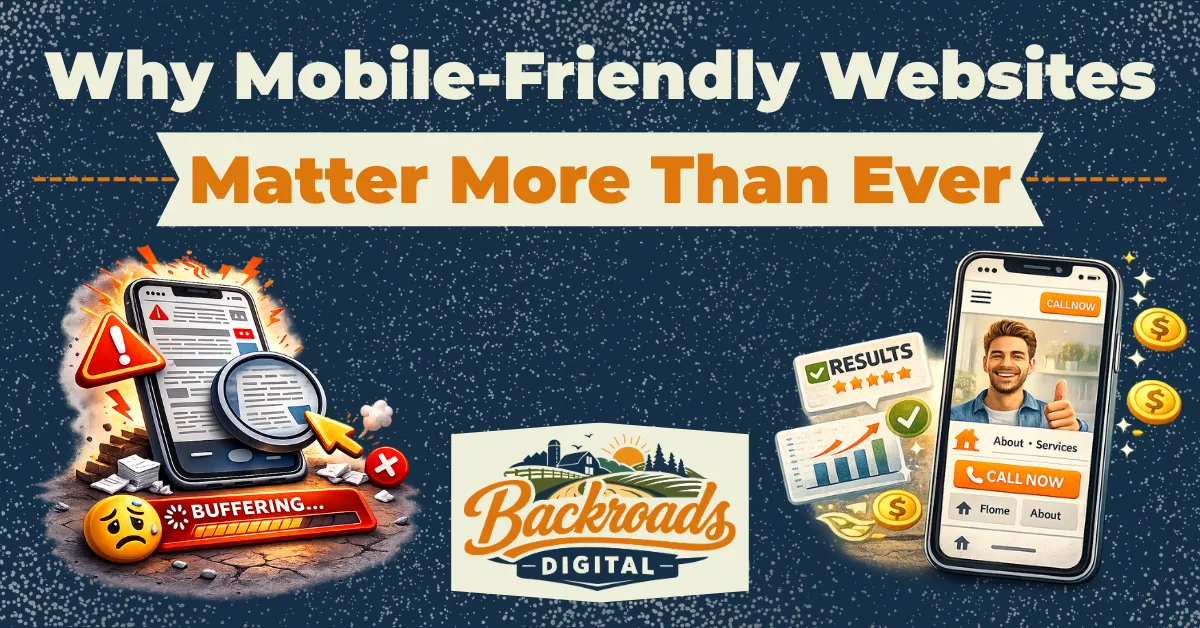
Why Mobile-Friendly Websites Matter More Than Ever

3/6/2026

 
Picture
​Take a moment and think about how you search for things during the day.

Looking up a restaurant.
Finding a business phone number.
Checking store hours.
Comparing services.

Most of the time, it happens on a phone.

For many local businesses today, more than half of website visitors come from mobile devices. In some industries, that number is even higher.

That’s why having a mobile-friendly website isn’t just a nice feature anymore.
It’s essential.

If your website doesn’t work well on smartphones, you could be losing potential customers before they ever contact you.

Let’s look at why mobile-friendly website design matters more than ever for small businesses.


Most Customers Visit Websites on Their Phones
Search behavior has changed dramatically over the past decade.

Today, many people:
  • Search on their phone first
  • Make decisions quickly
  • Expect information instantly

Someone might search:
“plumber near me”
“best coffee shop in Bonham”
“digital marketing company near me”

If your website appears in search results but doesn’t display properly on a mobile device, visitors often leave within seconds.

That means fewer calls, fewer inquiries, and fewer customers.

A mobile-friendly website ensures visitors can easily browse your services, read information, and contact you directly from their phone.


Mobile Optimization Improves Local SEO
Search engines like Google prioritize websites that provide a good mobile experience.

In fact, Google uses mobile-first indexing, which means it primarily evaluates the mobile version of your website when determining rankings.

A poorly optimized mobile site can hurt your visibility in search results.

A well-optimized mobile site can help with:
  • Local SEO rankings
  • Website visibility
  • Search traffic
  • Customer discovery
For local businesses, that visibility can make a major difference.

When someone searches for services in your area, you want your website to appear — and perform well once they click.
See Our Website & SEO Services
Mobile-Friendly Sites Create Better User Experiences
Think about what it feels like to visit a poorly designed mobile website.

Tiny text you have to zoom in to read.
Buttons that are hard to tap.
Menus that don’t work.
Pages that take forever to load.

Most visitors won’t struggle through that experience.

They’ll simply leave and try another business.

A mobile-friendly website design makes browsing easy by providing:
  • Clear navigation
  • Readable text
  • Easy-to-tap buttons
  • Fast loading pages
  • Simple contact options
A smooth experience keeps visitors on your site longer — and increases the chances they’ll reach out.


Mobile Users Often Have Immediate Intent
When someone searches on a phone, they often want to take action quickly.

They may be looking to:
  • Call a business
  • Get directions
  • Book a service
  • Send a message
  • Check hours
A mobile-friendly website makes these actions easy.

Features like click-to-call buttons, simple contact forms, and easy navigation help visitors quickly move from browsing to becoming customers.

​That’s why mobile optimization plays a key role in website conversion rates.
Improve Your Website's Mobile Experience
Speed Matters Even More on Mobile
Page speed is important for all websites, but it’s especially important for mobile users.

If your site takes too long to load on a phone, visitors often leave before the page finishes loading.

Slow mobile websites can lead to:
  • Higher bounce rates
  • Lower engagement
  • Fewer conversions
Fast-loading pages improve both search engine performance and user experience.

Even small improvements in load speed can make a noticeable difference.


Mobile-Friendly Design Builds Trust
Your website often forms a visitor’s first impression of your business.

If the site looks outdated or difficult to use on mobile devices, visitors may question the professionalism of the company behind it.

A modern, responsive website signals that your business is:
  • Active
  • Professional
  • Trustworthy
  • Easy to work with
For small businesses competing locally, those impressions matter.

Customers tend to choose companies that appear organized and credible online.


Mobile-Friendly Websites Support Social Media Traffic
Many people discover businesses through social media platforms like Facebook and Instagram.

When someone clicks a link in a social post, they are almost always using their phone.

If your website isn’t optimized for mobile devices, those visitors may quickly leave.

A mobile-friendly site ensures that social media traffic turns into meaningful engagement rather than missed opportunities.


The Bottom Line
Your website should work for you — not against you.

In today’s mobile-first world, a mobile-friendly website is one of the most important tools a local business can have.

It helps you:
  • Show up in search results
  • Create better user experiences
  • Build trust with potential customers
  • Convert visitors into leads
If your website doesn’t perform well on smartphones, it may be costing you more opportunities than you realize.


Final Thoughts
The way people search, browse, and choose businesses has changed.
Mobile devices are now at the center of that experience.

That means websites must be designed with mobile usability, speed, and simplicity in mind.

A well-optimized website doesn’t just look good — it helps customers find you, understand what you offer, and take the next step.

​And that’s what turns visitors into customers.
Get a Website that Works on Every Device

    Trevor Williams

    Owner - Backroads Digital

    Archives

    May 2026
    April 2026
    March 2026
    February 2026
    January 2026

    Categories

    All
    Google
    SEO

    RSS Feed

Services

About us

Social Media Management
Website/SEO
Email Marketing
Text Messaging Marketing

Community Media

Privacy POlicy

Contact

903-300-6209
​[email protected]
© COPYRIGHT 2026. Backroads Digital LLC.
✞​ Whatever you do, work heartily, as for the Lord and not for men, knowing that from the Lord you will receive the inheritance as your reward. ✞​ Colossians 3:23-24 ESV
  • Home
  • About
  • Business Services
    • Social Media Management
    • Social Media Setup
    • Website/SEO
    • Email Marketing
    • Text Message Marketing
    • Frequently Asked Questions (FAQ)
  • Media Digitizing
  • Blog
  • Contact